Two synagogues, a vast old cemetery and narrow lanes that seem frozen in time: the Jewish Quarter of Třebíč, in the Moravian region of the Czech Republic, is one of the largest and best-preserved Jewish quarters in Europe. Together with the Jewish cemetery and the nearby Basilica of St Procopius, it is a UNESCO World Heritage Site – the first Jewish monument outside Israel to be inscribed on the list in its own right.
Jews and Christians lived side by side in Třebíč from as early as the 12th century, shaping this unusual town together. Today 123 houses from different periods and in different styles still stand, reflecting many generations of vibrant Jewish life.
The story of the Jewish Quarter of Třebíč
For centuries, the Jews of Třebíč were not allowed to live in the Christian parts of the town and were confined to an area on the left bank of the Jihlava River, where the Jewish quarter of Zámostí grew up. The community flourished for hundreds of years, but during the Holocaust most of the town’s Jews were deported and murdered, and the Jewish community of Třebíč ceased to exist. The houses, however, survived, preserving a rare picture of Jewish life in Central Europe.
What to see in the Jewish Quarter
- The Rear Synagogue (Zadní synagoga): beautifully restored, with colourful wall paintings and a permanent exhibition on the history of the quarter, Jewish family life and Jewish food traditions. Look for the model of the quarter as it once was.
- The Front Synagogue: the second surviving synagogue, today used as a church.
- The historic buildings: the Jewish town hall, the rabbi’s house, a poorhouse, a school and a hospital, along narrow streets, covered passages and distinctive balconies.
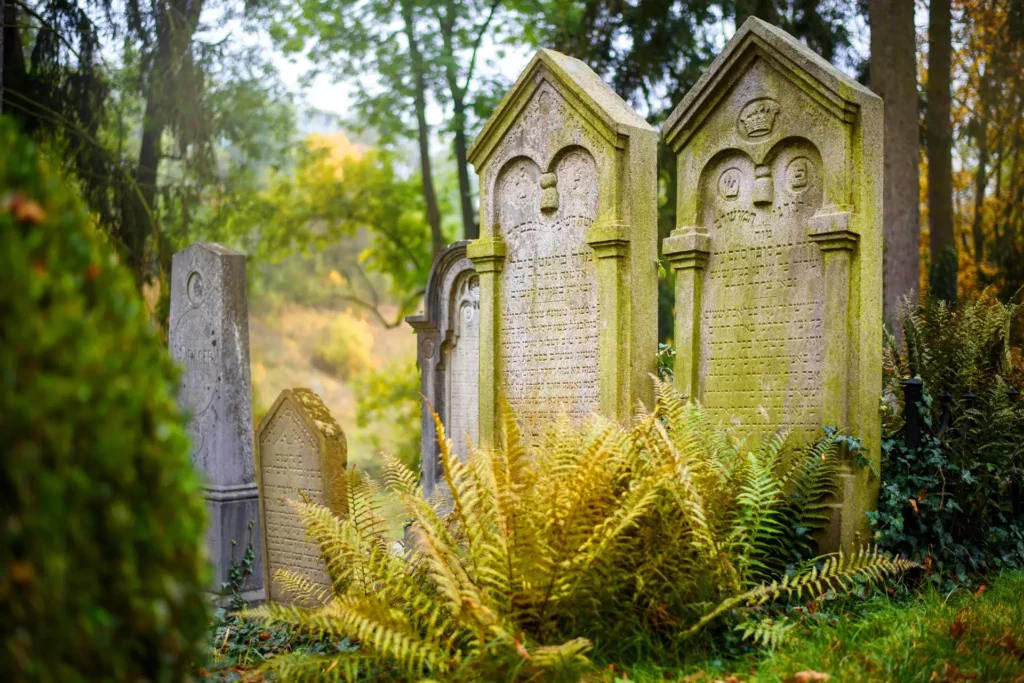
- The Jewish cemetery: one of the largest in the Czech Republic, with more than 2,000 tombstones crowded together under the trees and covered in ivy. The atmosphere is mysterious and moving.
The Christian side of town
Across the river, the town centre is built around the spacious Charles Square (Karlovo náměstí), home to the Painted House (Malovaný dům), a Renaissance building decorated with sgraffito, and the tourist information centre. In the grounds of the castle stands the Romanesque-Gothic Basilica of St Procopius, famous for its richly carved northern portal, known as the “gate of paradise” (porta paradisi).
What else is nearby?
- Telč: one of the prettiest towns in the Czech Republic, with a market square lined with colourful Renaissance houses – also a UNESCO World Heritage Site.
- Brno: the Czech Republic’s second city, about an hour away, with a lively centre and the modernist Villa Tugendhat.
Getting there
Třebíč is about two and a half hours’ drive from Prague and around an hour from Brno. It makes a great stop on a road trip through Moravia, combined with other Czech highlights such as Český Krumlov and the country’s most beautiful castles.
For more Jewish heritage travel, see our guides to kosher and Jewish Prague and Budapest’s Jewish Quarter.
In cooperation with CzechTourism.