
Millions of people looked up to the skies yesterday to witness one of the most impressive natural events seen in Europe in recent years: the moon passed between the Earth and the sun, darkening entire regions, and in parts of Spain and Iceland, it completely obscured the sun. So why did this happen, where did it go completely dark – and when will it happen again? If you encountered almost unreal images on social media yesterday, skies suddenly darkening, the sun turning into a ring of light, and crowds of people looking up with special glasses – it wasn’t a filter or an unusual weather phenomenon. Yesterday, on August 12, 2026, a total solar eclipse occurred, and Europe experienced one of its most remarkable astronomical displays in decades. Millions of people went out to watch the event. In some areas, the sun disappeared completely for a short time, while in other countries, the moon covered more than 90% of it.
So what exactly happened to the sun?
The simple answer is: nothing happened to the sun. A solar eclipse occurs when the moon passes exactly between the Earth and the sun. From our perspective, the moon obscures part of the sun – and in areas where the three bodies are aligned correctly, it can completely cover it. During a total eclipse, the moon’s shadow moves across the Earth in a relatively narrow path. Those within that path see the sun disappear completely for a short time; those outside it see only part of it obscured. And that’s exactly what happened yesterday.
Where did the sun disappear completely?
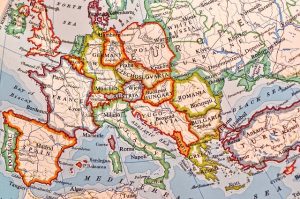
The path of the total eclipse passed through relatively limited areas. It crossed regions in Greenland and Iceland, continued over the Atlantic Ocean, and reached northern Spain and a small edge of Portugal. In some places along the path, the total eclipse could be observed for more than two minutes. At those moments, the moon completely covered the sun’s disk, the skies darkened, and the sun’s glowing outer atmosphere could be seen. In Spain, one of the event’s most dramatic moments occurred near sunset when the moon’s shadow passed over the northern part of the country.
And in the UK? Almost total darkness
The UK was not within the path of the total eclipse, but for the British, it was still an extraordinary event. In large parts of the country, the moon obscured about 90% of the sun, and in some areas even more. It was the most significant solar eclipse visible from the British Isles since 1999. Crowds gathered in parks, observation points, and well-known sites to watch the event, and in areas where the skies remained clear, the moon could be seen gradually “biting” into the sun.
Why did it suddenly get dark?
This is the part that makes a total solar eclipse such an unusual experience. As the moon covers more of the sun, the amount of sunlight reaching the ground decreases rapidly. During a total eclipse, in that narrow band where the moon completely obscures the sun, daylight can quickly turn to twilight. The temperature may also drop during the event. And when the moon finally covers the sun entirely, a whitish and delicate glow can be seen, usually drowned out by the sun’s powerful light.
Why was everyone so excited?
Solar eclipses are not particularly rare phenomena when looking at the entire Earth. But a total eclipse in a specific location is a completely different story. The path of the total eclipse is very narrow, so you need to be in the right place at the right time to see the sun disappear completely. Yesterday’s eclipse was the first that could be seen as a total eclipse in parts of central or western Europe since 1999. This is why thousands of astronomy enthusiasts and tourists planned trips specifically to areas within the eclipse path.
And there’s another one on the way
Those who missed the event won’t necessarily have to wait decades. On August 2, 2027, another total solar eclipse is expected, which will also be visible in certain parts of Spain, alongside other regions. But for some places that experienced yesterday’s eclipse, a similar event might be much further away.
Important: Do not look directly at the sun
Even when 90% or more of the sun is obscured, the remaining visible part can still cause severe eye damage. Viewing a partial eclipse should be done using dedicated eclipse glasses that meet the appropriate standard, not with regular sunglasses.
In summary: What happened yesterday in Europe?
The sun did not change or “go out.” The moon simply passed exactly between it and the Earth, and in certain areas, its shadow completely obscured it. In Greenland, Iceland, Spain, and a small area in Portugal, a total eclipse could be seen, while in Britain and large parts of Europe, a significant partial eclipse was observed. For a few rare minutes, millions of people simply stopped what they were doing and looked up to the sky. And this time, they certainly had something to see.
 Find the best flight deals – click here