
My name is Miki Spitzer. I am a nature and landscape photographer, working in Israel and around the world. I chase spectacular sunsets, erupting volcanoes, calving glaciers, the northern lights and every good thing nature has to offer. Chasing tornadoes was next on my list.
I had always wanted to document storms. The thrill pulls me like a magnet, and this time I decided to make that dream come true. I got in touch with a storm chaser from Iowa and set off.
Nine states and more than 6,000 kilometres
I landed in Omaha, Nebraska, and from there we began a very long drive. We crossed nine states and covered more than 6,000 km, all in a little over a week!
The chase is challenging, frightening and exciting. It is unpredictable and sometimes disappointing, but above all it is impressive. I did not see a tornado every day. When I did, it was an awesome monster, charging forward and wiping out whatever lay in its path.
Colorado: thousands of lightning strikes
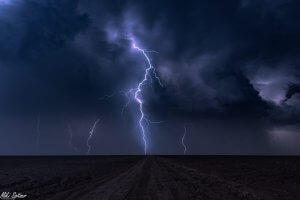
The journey began with a ten-hour drive (yes, that is how it goes when you chase storms) from Nebraska to Colorado. The forecast promised an interesting storm. We drove all the way there and the storm was late. Only towards nightfall did towering, charged clouds roll in and pound the area with thousands of lightning bolts. It was a crazy experience: hundreds of flashes exploding in front of my eyes every minute.
The next day we drove from Colorado to Kansas, where a storm was expected. Unfortunately, huge wildfires in New Mexico affected the flow of the clouds and the storm never developed.
Iowa and Minnesota: a perfect supercell
On the Iowa-Minnesota border a beautiful, thoroughly photogenic storm took shape. You have to know to shoot from the side of a storm, not from underneath it. Otherwise you get torrential rain or, worse, hail the size of baseballs.
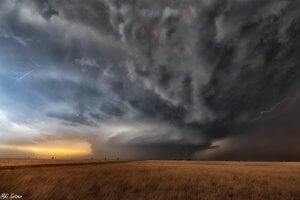
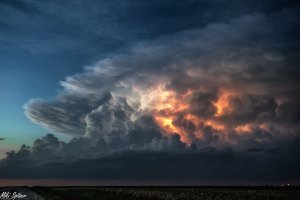
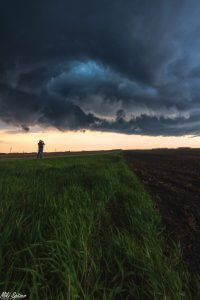
Later we drove back into Iowa, where a perfect, photogenic supercell formed. You can actually see the clouds rotating and moving in front of you. We stayed right with it until after sunset. Then a lightning show began inside the massive bank of cloud, and it looked exactly like a volcano.



Chasing tornadoes in Texas
We made our way to the town of Joplin, Missouri. Eleven years earlier a massive tornado had killed 161 people there, and you can still see the damage it caused.
From there we headed to Texas, ahead of a forecast for a very big storm in the west of the state, on the border with New Mexico. A giant storm did arrive, one that produced several tornadoes. Some of them I managed to see and photograph. Others were very hard to make out.
Along with the tornado came a huge dust storm, what is called a haboob, which makes seeing and driving extremely difficult.
Face to face with a tornado
Luckily for me, one of the most impressive tornadoes was really close to us. About a dozen other storm chasers stood alongside, cheering as it approached. My phone kept buzzing with alerts: take shelter, there is a tornado.
Hunter, my guide, was very careful. The closer we got to the storm, the more he made sure we always had an escape route in every direction. A tornado is unpredictable. It can change direction, speed and size in a second. (There are stories of storm chasers killed by a storm that took them by surprise.) He kept asking me to look up and to the sides, in case something was suddenly forming above us.
Seeing the tornado, hearing the wind and feeling the adrenaline is a thrilling and dangerous experience. Doing it alone would be extremely risky. You need an experienced guide.
Back to Minnesota
We drove back to Minnesota, where tornadoes had begun to form, but they were very hard to see because they were wrapped in rain. The clouds, though, were dramatic, low and beautiful.
In summary
A tornado is a magnificent thing. You truly see how great the works of creation are. But it is really dangerous. Do not go alone: only with an experienced guide and the right equipment.
More of Miki’s work: the northern lights in Iceland and the tulip bloom in the Netherlands.