

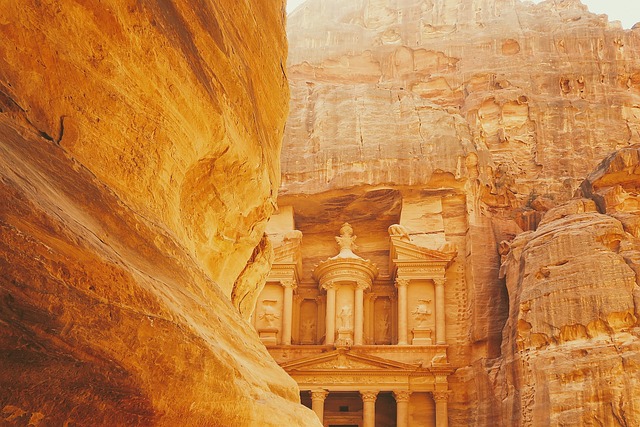
Few places in the world make an entrance quite like Petra. After walking through a narrow, winding canyon, you suddenly see the Treasury, a temple facade carved straight into the pink sandstone cliff. Built more than 2,000 years ago by the Nabataeans and named one of the New Seven Wonders of the World, Petra is Jordan’s greatest treasure and an unforgettable experience. Here is what you need to know to plan your visit.
The highlights of Petra
The Siq
Your visit begins with the Siq, a dramatic gorge more than a kilometre long, with rock walls up to 80 metres high. Look for the remains of the Nabataean water channels carved along its sides.
The Treasury (Al-Khazneh)
At the end of the Siq, the Treasury appears – the symbol of Petra and one of the most photographed monuments on Earth. Despite its name, it was most likely a royal tomb. The light on its facade is at its best in the morning.
The Street of Facades and the Royal Tombs
Beyond the Treasury, the valley opens up into a city of tombs, temples and dwellings cut into the cliffs. The Royal Tombs, with their swirling coloured rock, are especially impressive.
The Theatre and the Great Temple
The Nabataeans carved a theatre into the mountainside that could seat several thousand people, while the Great Temple complex shows the city’s Roman-era grandeur.
The Monastery (Ad-Deir)
Climb around 800 rock-cut steps to reach the Monastery, an enormous monument even larger than the Treasury. The effort is rewarded with breathtaking views over the surrounding mountains and valleys.
Petra by Night
On selected evenings, the Siq and the Treasury are lit by hundreds of candles for a magical night-time experience.
History and culture
Petra was the capital of the Nabataean kingdom and an important trading centre, at the crossroads of caravan routes linking Arabia, Egypt and the Mediterranean. The Nabataeans were masters of water management, building channels, cisterns and dams that turned the desert into a thriving city. After a series of earthquakes and shifting trade routes, the city declined, and it was known only to local Bedouin until a Swiss explorer brought it to European attention in 1812. Today it is a UNESCO World Heritage Site.
Tips for visiting Petra
- Arrive early: the site opens in the morning, and the first hours are cooler and much quieter.
- Allow enough time: one full day is the minimum; two days let you see the Monastery and the quieter trails without rushing.
- Bring water, a hat and good shoes: you will walk many kilometres, often in strong sun.
- Choose the season: spring and autumn are ideal. Summer is very hot, and winter can be cold and occasionally rainy.
- Hire a guide: a local guide brings the history to life and shows you lesser-known corners.
- Consider the Jordan Pass: for many visitors, it combines the visa fee with entry to Petra and other sites.
Getting to Petra from Israel
Petra is in southern Jordan, about two hours’ drive from the Eilat-Aqaba crossing and around three hours from Amman. Many Israelis visit on organised tours. If you are travelling overland, read our guides to the Jordan River Crossing and the Allenby Crossing, and always check current travel advisories and crossing rules before you go.
Looking for more desert scenery closer to home? See our guide to the Dead Sea.


